Replace a Tail with a Wing
Two tails, one engine
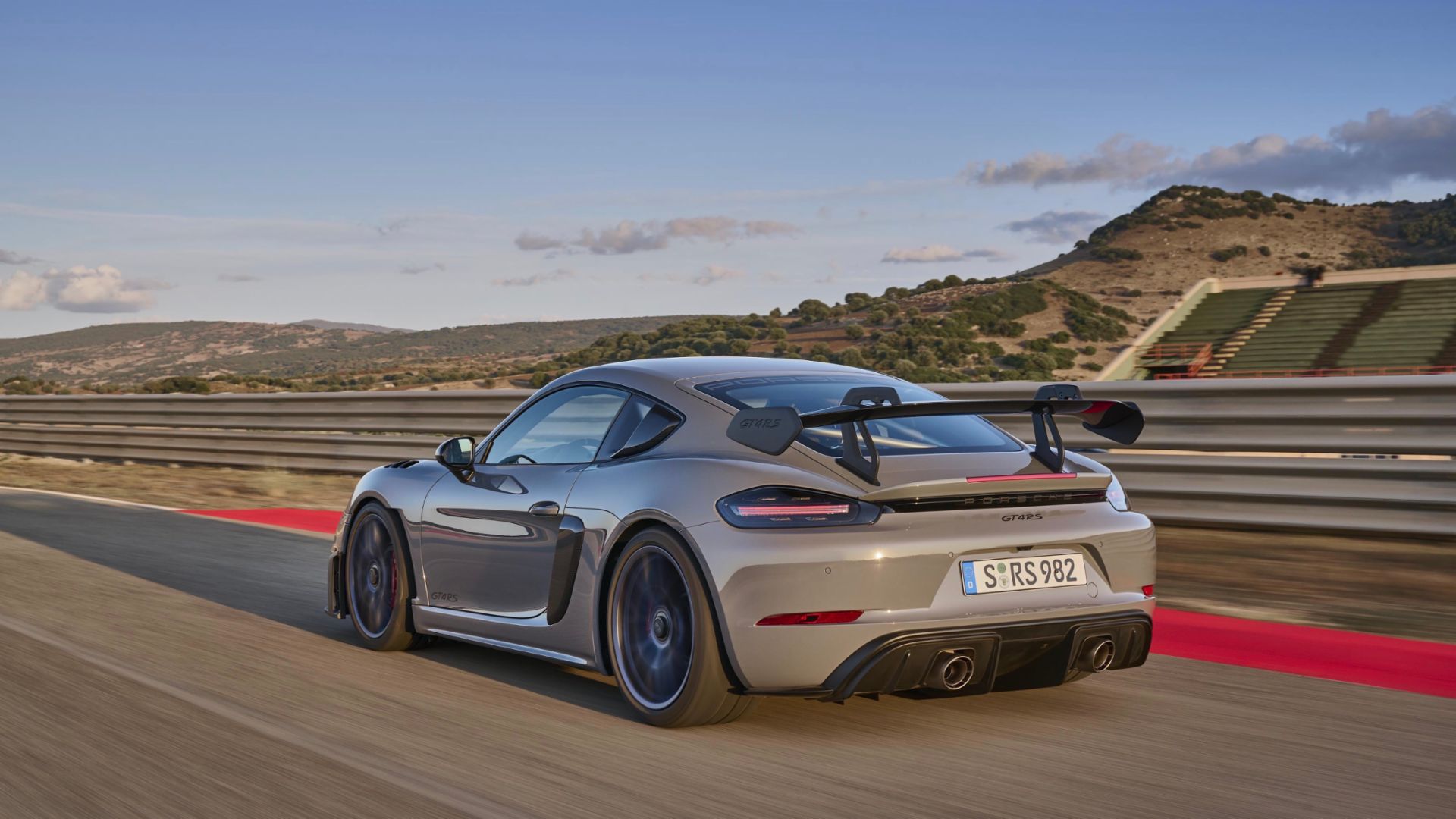
The 718 Cayman GT4 RS and the 718 Spyder RS share a platform, a wheelbase, a 4.0-liter naturally aspirated flat-six derived from the 911 GT3's engine, and a PDK gearbox calibrated for violence. The GT4 RS weighs 1,415 kg. The Spyder RS weighs 1,410 kg — five kilograms lighter despite being the open-top car, thanks in part to a soft-top that weighs just 18.3 kg and the absence of the heavy swan-neck wing and its reinforced mounting structure. They produce the same 493 hp. They are, mechanically, nearly the same car. But stand behind them and they could not look more different.
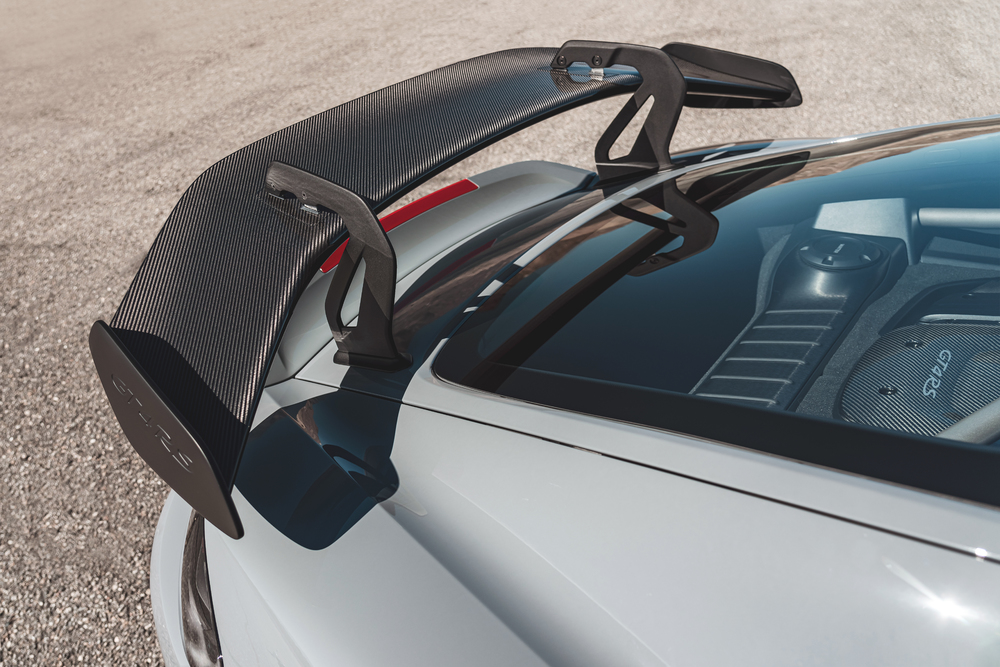
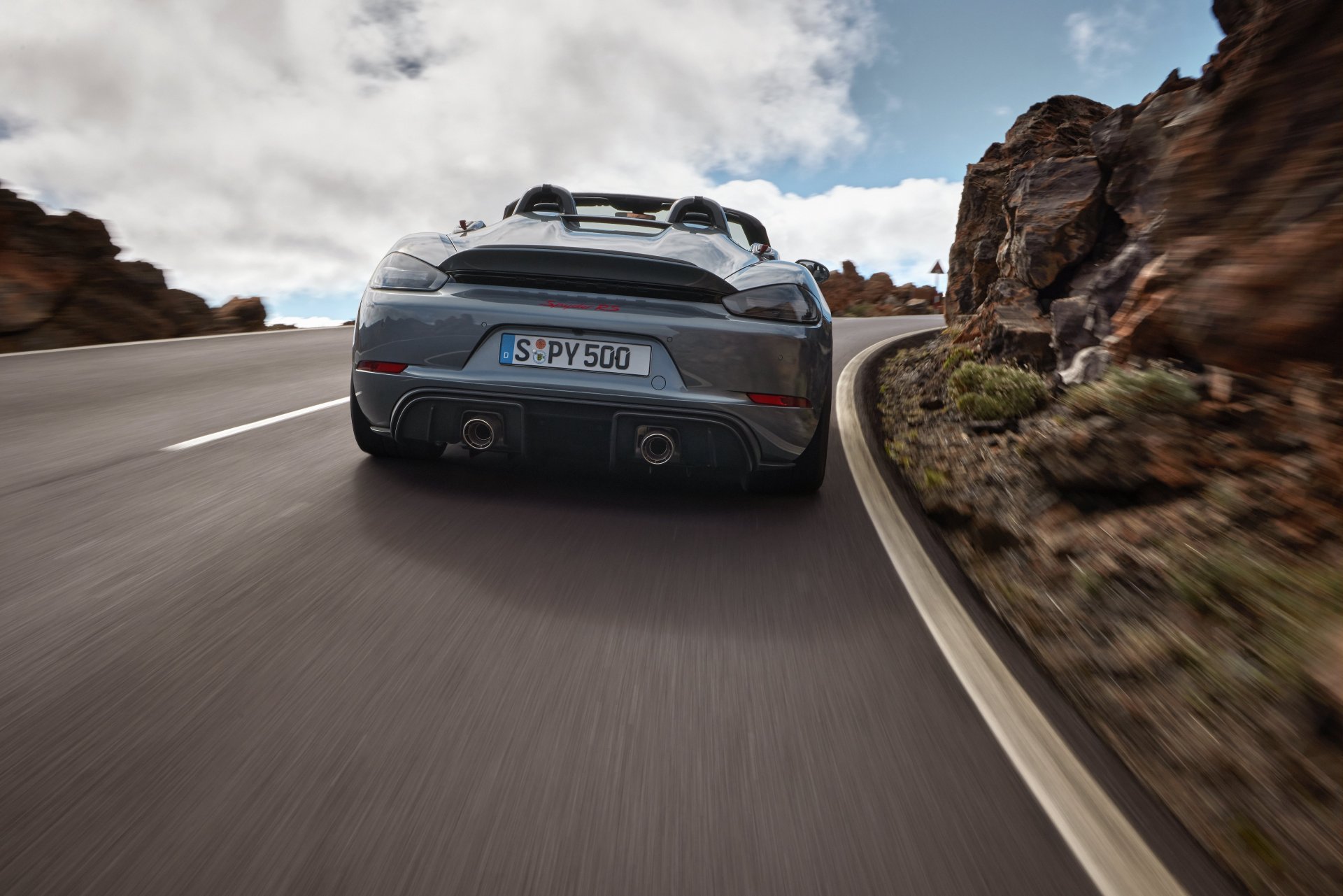
The GT4 RS wears a swan-neck rear wing — a proper aerofoil mounted on aluminum uprights that attach to the wing's upper surface, leaving the underside clean and aerodynamically unobstructed. The Spyder RS wears a fixed ducktail — a subtle lip integrated into the rear deck that nudges airflow upward as it leaves the bodywork. One is a statement. The other is a whisper. And the distance between them is not cosmetic.
Owners look at the two cars and see a parts-bin opportunity. The GT4 RS wing bolts to the same rear quarters. The mounting points are close enough to make swapping seem trivial. Forums are full of Spyder RS owners sketching out wing conversions, convinced that the GT4 RS's aerofoil is a free upgrade — more downforce, more grip, more speed, bolted on over a weekend. It is not. The wing and the tail were chosen for their respective cars because each car's entire aerodynamic balance was developed around the device it wears. Swapping one for the other does not add downforce. It redistributes it, and redistribution without recalibration is just another word for imbalance.
| GT4 RS | Spyder RS | Spyder RS Weissach | |
|---|---|---|---|
| Rear aero device | Swan-neck wing | Fixed ducktail | Fixed ducktail + gurney flap |
| Downforce at 200 km/h | 89 kg (Performance position) | ~16 kg (est. from 718 Spyder baseline) | ~20–25 kg (est.) |
| Drag coefficient (Cd) | 0.33 | ~0.32 (est. from 718 family) | ~0.325 (est.; gurney adds drag) |
| Frontal area | 2.033 m² | ~1.99 m² | ~1.99 m² |
| Curb weight | 1,415 kg | 1,410 kg | ~1,395 kg (est.; carbon panels) |
| Front splitter | Full-length, aggressive | Shorter lip, matched to ducktail | Shorter lip, matched to ducktail |
| Diffuser contribution | ~30% of rear downforce | ~50% of rear downforce | ~40–45% of rear downforce (est.) |
| Airflow management | Clean flow over fixed roof | Windshield deflector + tonneau | Recalibrated deflector + tonneau |
What a wing does that a tail cannot
A rear wing is an inverted aerofoil. Air flows over and under it, and the pressure differential pushes the wing — and the car — downward. The GT4 RS's swan-neck design is critical here: by mounting the uprights to the top surface of the wing, Porsche leaves the aerodynamically important underside completely unobstructed. The underside of a wing element does more work than the top in generating downforce, and any mounting hardware disrupting flow there costs efficiency. The GT4 RS wing generates 89 kg of total downforce at 200 km/h in its Performance position — a 25% improvement over the standard GT4, which itself produces up to 150 kg at top speed with its fixed wing and a rear diffuser responsible for 30% of rear-axle load. The numbers are large enough to materially change how the rear tires behave under cornering load.
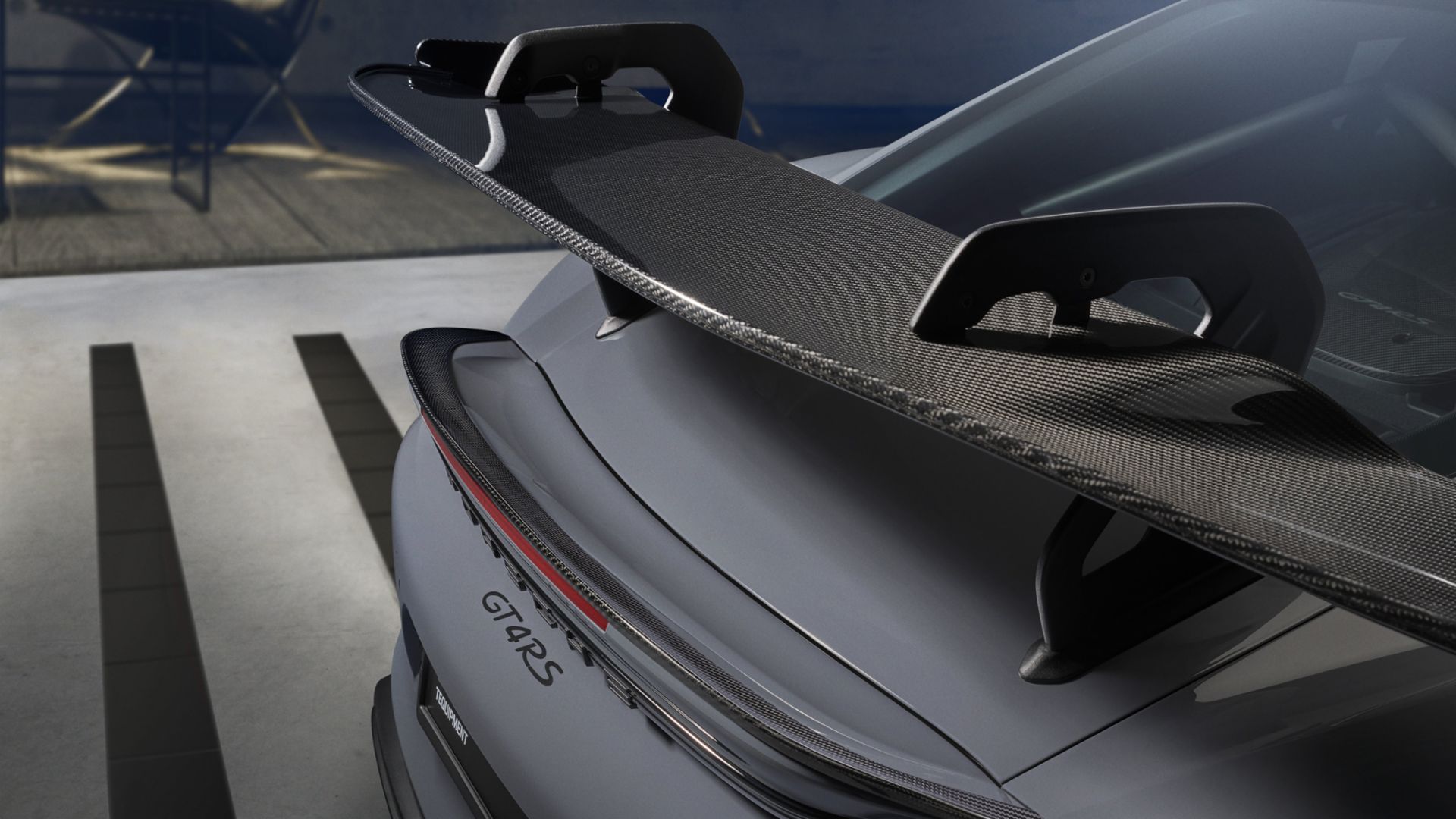
The wing is manually adjustable between two positions — approximately 1° angle of attack for the Speed setting and 4° for Performance — changed by moving the rear bolt to the opposite end of a figure-8-shaped slot in each upright. The difference between those three degrees is substantial: the Performance setting loads the rear axle hard enough to transform the GT4 RS from a balanced mid-engine sports car into something that rotates around its center of mass with startling willingness, the rear tires following the front through high-speed corners with an obedience that borders on aggression. Porsche validated the concept further with the Manthey Kit, which replaces the stock wing with one 85 mm wider, adds larger endplates, and offers four angle-of-attack stages instead of two — pushing total downforce from 89 kg to 169 kg at 200 km/h and shaving 6.2 seconds from the car's Nürburgring lap time.
A ducktail does something fundamentally different. It does not generate downforce through a pressure differential across an aerofoil. Instead, it works by modifying the separation point of airflow leaving the rear deck. Without a ducktail, air flowing over the rear of a fastback shape separates turbulently, creating a low-pressure wake that produces lift. The ducktail kicks the airflow upward at the trailing edge, delaying separation and reducing that wake. The result is less lift rather than more downforce — a critical distinction. Porsche knows exactly how much this matters: on the original 1973 Carrera RS 2.7, the ducktail reduced the rear lift coefficient from 0.29 to 0.08 — a 72% reduction — and added 4.5 km/h to the car's top speed. The device that defined Porsche's aerodynamic identity did not push the car down. It stopped the car from lifting up.
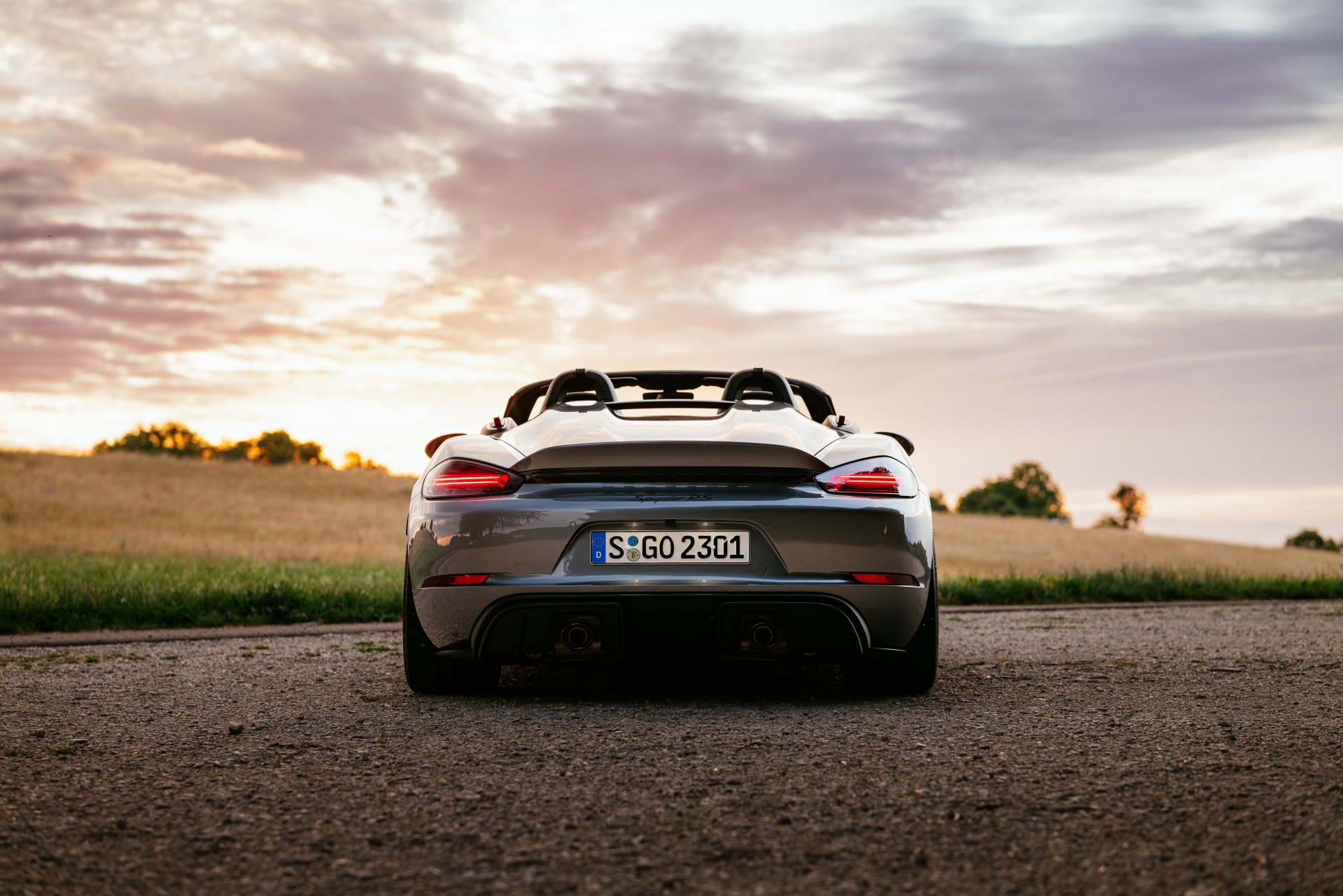
Porsche's stated aerodynamic target for the Spyder RS was not maximum downforce but zero lift: optimal driving stability in all conditions. The standard 718 Spyder — with its smaller, automatically deploying spoiler — generates approximately 16 kg of total rear-axle downforce at 200 km/h, with the rear diffuser accounting for roughly 50% of that figure. The Spyder RS's larger, fixed ducktail improves on the standard car, but the improvement is incremental, not transformative. Porsche does not publish a specific downforce number for the Spyder RS, and the reason is telling: the number is small enough that advertising it would invite the wrong comparison. The GT4 RS's 89 kg at the same speed is not a different point on the same scale. It is a different scale entirely. The Spyder RS's ducktail is not trying to compete with the GT4 RS's wing on downforce. It is solving a different problem — generating its stability from the underbody and the diffuser, not from a device mounted in the airstream above the deck.
Why a wing does not work on an open car
Porsche's engineers were explicit about this: they deliberately chose not to put the GT4 RS's adjustable wing on the Spyder RS. The reason is not weight, cost, or aesthetics. It is physics.
A rear wing's efficiency depends on receiving clean, laminar airflow. On the GT4 RS, air flows over the fixed roof, across the rear window, and arrives at the wing in an organized, predictable stream. The wing can work as designed because it knows what kind of air it is getting. On the Spyder RS, there is no roof. Air tumbles into the open cockpit, swirls around the cabin, and exits over the rear deck as turbulent, disrupted flow. A wing mounted in that disturbed air does not generate the downforce its profile promises — it generates inconsistent, unpredictable forces that change with speed, wind angle, and whether the windows are up or down. At best, the wing underperforms. At worst, it introduces handling characteristics that vary corner to corner.
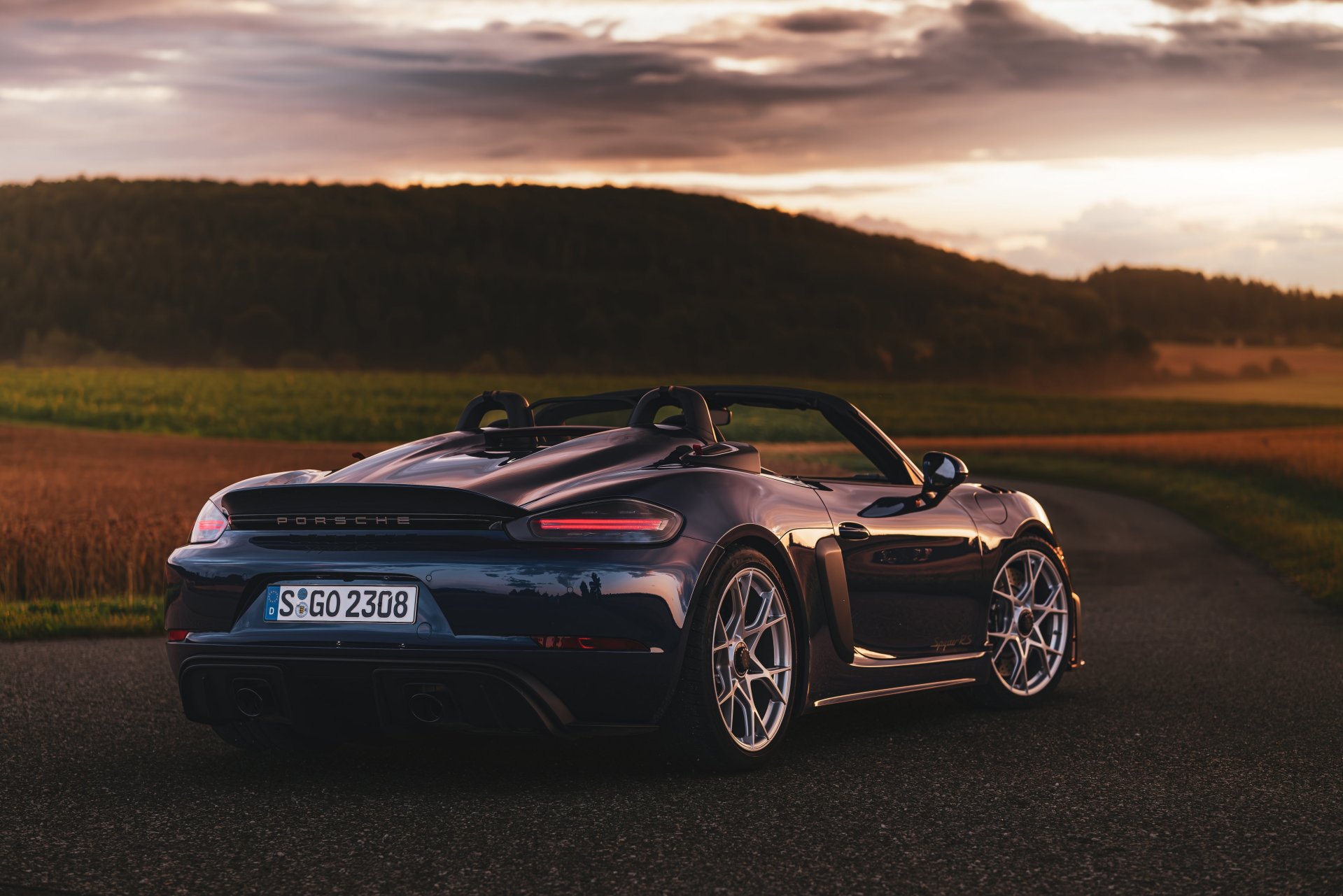
The ducktail does not have this problem. Because it works by modifying the separation point of flow leaving the body surface — not by generating a pressure differential across an elevated aerofoil — it is far less sensitive to the quality of incoming air. Turbulent flow still separates from a trailing edge, and a lip still delays that separation. Wind tunnel testing of spoilers versus wings on comparable body shapes confirms the trade-off: wings produce more downforce at better lift-to-drag ratios (typically 3:1 to 24:1 versus 2:1 to 11.5:1 for spoilers), but that efficiency depends on clean air. In disrupted flow, the wing's advantage collapses while the ducktail's more modest contribution remains stable. Porsche chose predictability over peak performance, and for a car that will be driven on public roads in varying conditions, that is the correct trade.
The Weissach gurney flap
The Spyder RS Weissach package adds a gurney flap to the trailing edge of the ducktail — a small, perpendicular tab that runs the width of the lip. It is the smallest visible aerodynamic device on the car, and it is doing more work than it appears to.
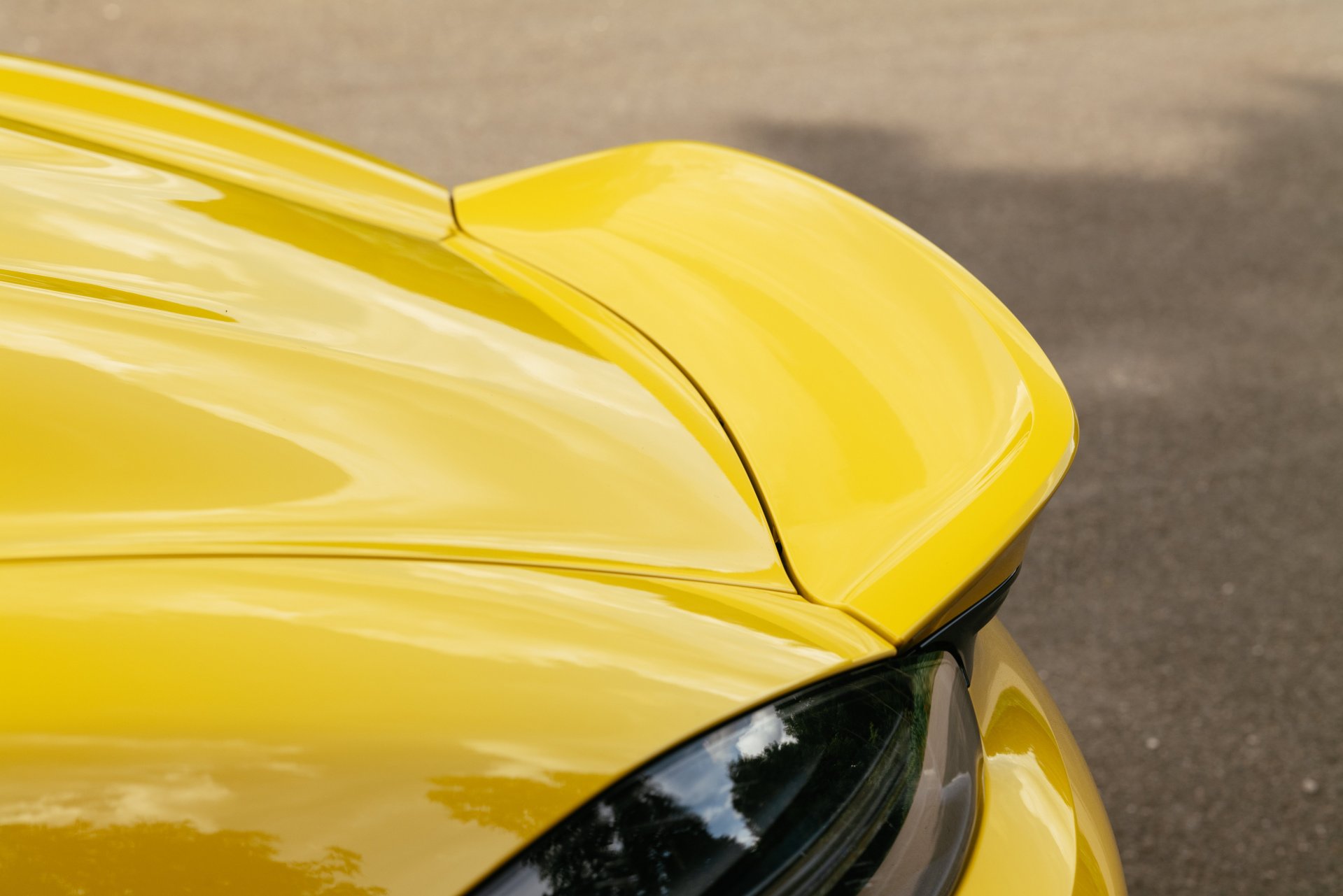
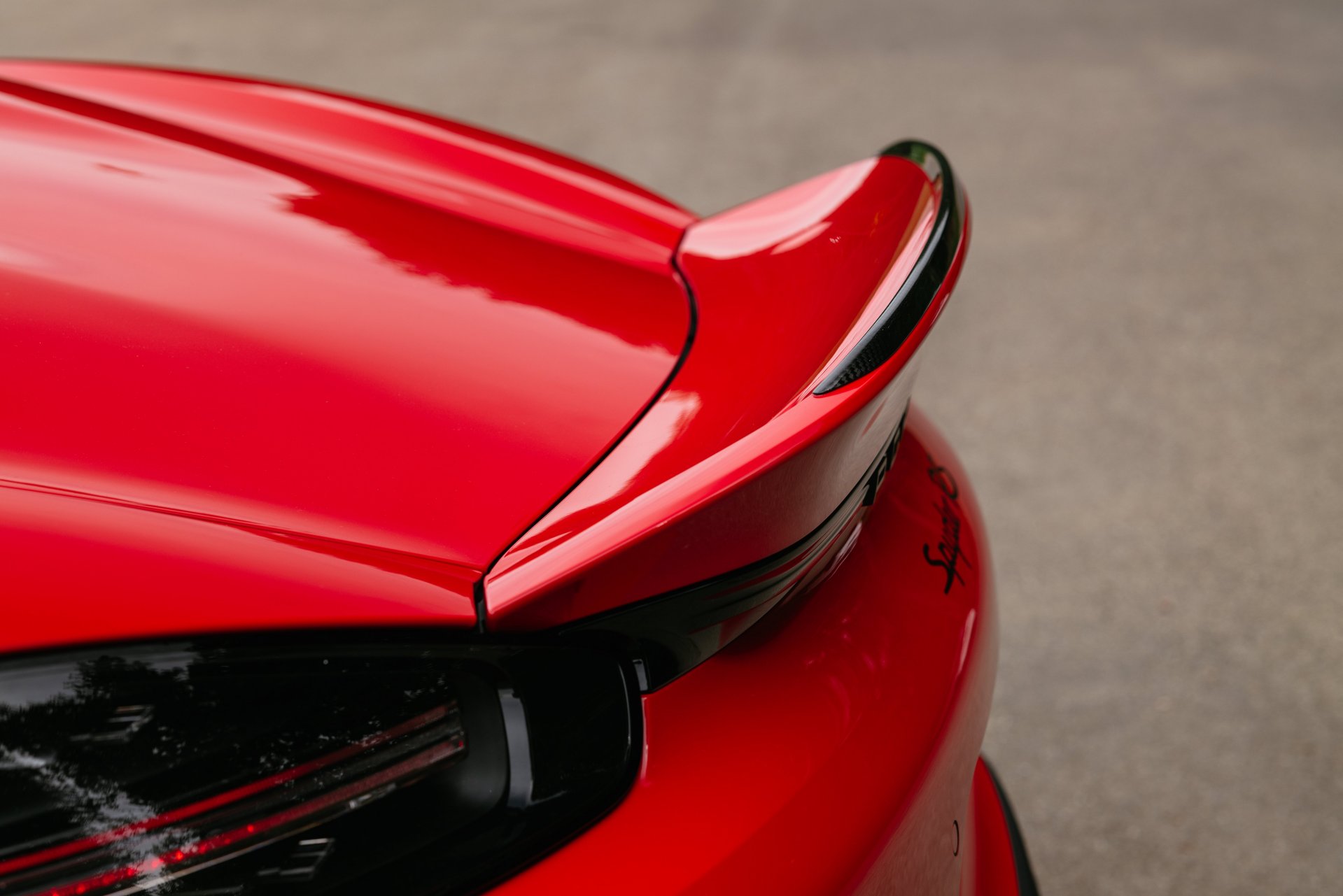
A gurney flap works by creating a small region of high pressure on its forward face and a controlled vortex behind it. The effect is disproportionate to its size: that tiny tab increases the ducktail's effective downforce contribution by a meaningful margin, sharpening the transition from lift reduction to genuine rear-axle loading. On the Weissach Spyder RS, the gurney flap is the difference between a rear end that feels neutral at 240 km/h and one that feels planted — a small additional push into the tarmac that gives the driver confidence the rear will not step out under high-speed braking or through long sweepers.
There were concerns during development about buffeting. A gurney flap on an open-top car creates turbulence directly upstream of the cabin's trailing edge, and at certain speeds that turbulence can set up a resonant oscillation — a rhythmic pressure pulse that beats against the driver's helmet or headrest. Porsche addressed this through the same air management system that keeps the Spyder RS's cabin livable at speed: the windshield header's integrated deflector and the fixed rear tonneau work together to manage airflow over the cockpit, preventing the gurney flap's wake from coupling with the cabin's pressure dynamics. The result is that the Weissach flap adds grip without adding discomfort, but it required the entire airflow path — from the windshield header to the rear deck — to be tuned as a system. Bolt a gurney flap onto a non-Weissach Spyder RS without the corresponding deflector calibration and you may get the downforce, but you will also get the headache.
The Manthey Kit proves the same point from the GT4 RS side: adding a gurney edge to the wing, widening it by 85 mm, and adding front wheel arch gurney flaps pushed downforce from 89 to 169 kg — but it also required new air curtains, a revised rear spoiler attachment, and recalibrated front-axle aero to keep the car balanced. Even on the closed-roof car, you cannot change the rear without changing the front.
Balance is the whole game
A car's aerodynamic balance is the ratio of front-axle downforce to rear-axle downforce. At any given speed, the front and rear of the car experience different aerodynamic forces, and the relationship between those forces determines how the car behaves. Too much rear downforce relative to the front and the car understeers at speed: the rear is glued down but the front is floating, washing out in fast corners. Too much front downforce relative to the rear and the car oversteers: the nose bites but the tail slides.
The GT4 RS was balanced around its wing. Porsche's aerodynamicists developed the front splitter, the underbody venturi tunnels, the side air curtains, and the rear diffuser to produce a specific amount of front-axle downforce that matches the wing's rear-axle contribution at the wing's baseline angle of attack. The diffuser alone accounts for roughly 30% of the car's rear-axle downforce, generating its contribution with virtually no drag penalty. Every element works in concert. The front and rear are in conversation, and the wing is one half of that conversation.
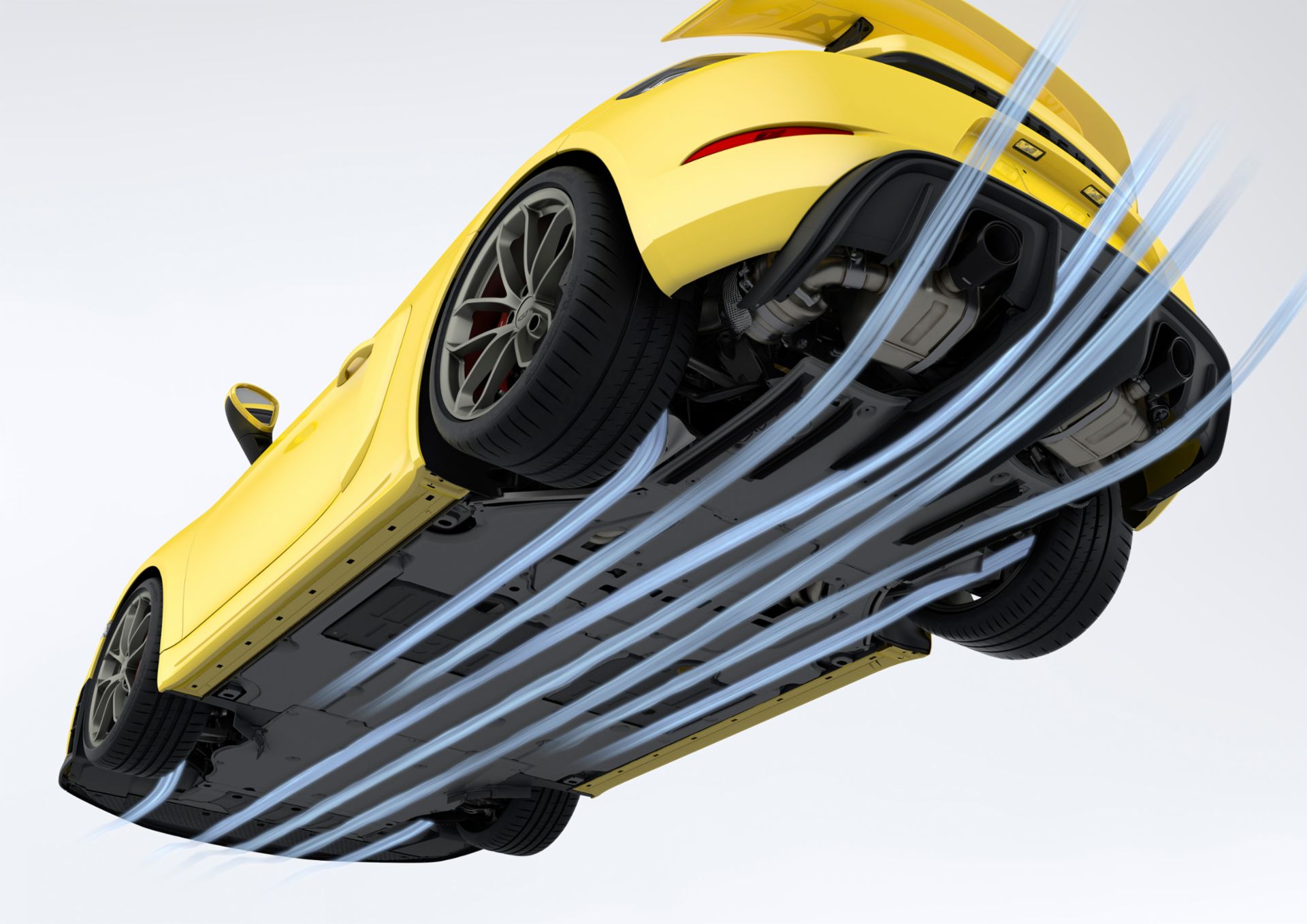
The Spyder RS was balanced around its ducktail. Because the ducktail generates perhaps a fifth of the rear downforce the wing does at 200 km/h, the rest of the car's aero package was calibrated to match — a deliberately shorter front splitter lip, a subtly different underbody profile, a diffuser responsible for roughly half the car's total rear-axle downforce rather than the GT4 RS's 30%. The drag coefficient is estimated at 0.32 — marginally lower than the GT4 RS's 0.33, reflecting the ducktail's smaller frontal profile compared to a raised wing — across a frontal area of approximately 1.99 m². The Spyder RS's aero balance is not worse than the GT4 RS's. It is different. Porsche's stated goal was "optimal driving stability in all driving conditions" — a car designed to feel neutral and progressive at the limit, with the front and rear reaching their grip limits at roughly the same rate.
Now bolt the GT4 RS's wing onto the Spyder RS. What happens? The wing expects to generate 89 kg of rear downforce at 200 km/h, but it is sitting in turbulent air from an open cockpit instead of the laminar flow it was designed for — the actual figure will be lower and inconsistent, varying with speed and wind angle. Even at a conservative estimate of 50–60 kg, it dwarfs the ducktail's roughly 16 kg contribution. Meanwhile, the front of the car has not changed. The shorter front splitter lip, the underbody tuned for the ducktail's lower energy airflow — all still producing the same modest front-axle loading they always did, while the rear is being pushed down with three to four times the force. The balance shifts rearward. The car understeers. Not a little. A lot. The front tires, no longer matched to the rear in aerodynamic loading, wash out in fast corners. The driver compensates with more steering input, which loads the front tires beyond their mechanical grip, which heats them, which degrades them, which makes the understeer worse. The car does not feel faster. It feels broken.
Experiment at your own peril
The temptation is understandable. The GT4 RS wing looks faster because it is the device worn by the faster car — the car that ran a 7:09.300 on the Nürburgring Nordschleife while Porsche never even published a lap time for the Spyder RS. And in the narrow sense that it produces more rear downforce, it is a higher-performance component. But a component does not exist in isolation. It exists within a system, and the system is the car.

Porsche did not put a ducktail on the Spyder RS because it was cheaper, or simpler, or because someone in marketing thought it looked better. They put a ducktail on the Spyder RS because the Spyder RS was engineered from the ground up to be balanced with a ducktail. Every spring rate, every damper setting, every anti-roll bar calibration, every alignment spec was set with the ducktail's aerodynamic contribution as a given. The front splitter was made shorter on purpose. The diffuser was tuned to carry a larger share of the rear downforce on purpose. These are not oversights. They are calibrations.
This is the lesson that applies far beyond the 718: at the level of engineering that goes into a modern GT car, there are no free upgrades. Every change propagates. A wing changes the aero balance, which changes the handling, which demands suspension changes, which alter the mechanical grip distribution, which require different tire pressures, which affect wear patterns, which change brake bias requirements. The Manthey Kit demonstrates the cost of doing it right: to gain 80 kg of downforce on the GT4 RS — a closed-roof car with clean airflow — Porsche needed a wider wing, larger endplates, new air curtains, front wheel arch gurney flaps, a revised rear spoiler attachment, and four wing-angle stages to let the driver re-tune the balance. All that to change one number on one car whose aero already worked. And it still cost 6.2 seconds on the Nürburgring.
Little changes make big differences. That is the entire point of aerodynamic development at this level — incremental refinements measured in single-digit percentages of lift coefficient, in millimeters of ride height, in fractions of a degree of wing angle. The GT4 RS and the Spyder RS are proof that two nearly identical cars can feel entirely different based on what happens to the air after it leaves the rear deck. Respect the engineering. The tail is not a lesser wing. It is exactly the device the car was built to wear.
The takeaway
The GT4 RS's swan-neck wing and the Spyder RS's ducktail are not interchangeable upgrades — they are the anchors of two completely different aerodynamic philosophies built on the same platform. The GT4 RS generates 89 kg of downforce at 200 km/h through clean airflow over a fixed roof; the Spyder RS generates roughly a fifth of that, targeting near-zero lift through turbulent air over an open cockpit, with its diffuser doing half the work. Swapping one device for the other does not improve the car — it breaks a balance that Porsche spent years calibrating. The Weissach package's gurney flap proves the point from the other direction: even the smallest aerodynamic addition required the entire airflow path to be re-validated. If you want more rear downforce, buy the GT4 RS. If you want the open-air experience with an engine that screams to 9,000 rpm, buy the Spyder RS. But do not buy one and try to turn it into the other. The engineers already considered it. They chose differently on purpose.